Why Hair Fall Spikes with the Seasons — Reasons May Surprise You
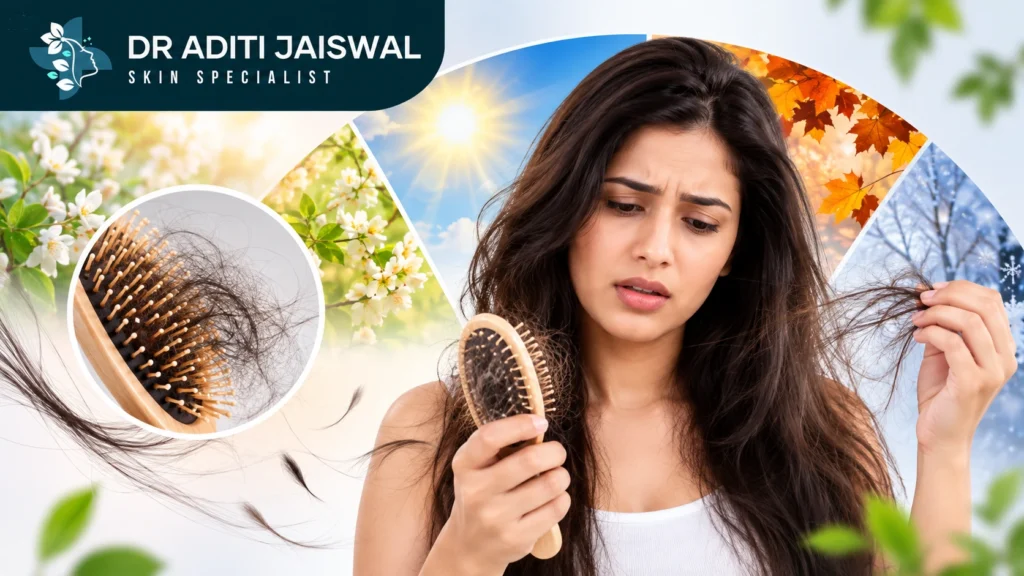
Why Hair Fall Spikes with the Seasons — Reasons May Surprise You Seasonal hair fall causes: If you’ve noticed noticeably more hair in your brush or shower drain this time of year, it likely has nothing to do with your shampoo, your stress levels, or anything you’ve done wrong. A long-running study published in the British Journal of Dermatology tracked shedding patterns over time and found something striking: hair loss peaks in late summer and early autumn, with people losing about 60 strands a day on average—more than double what the same people shed during the preceding winter months. What’s genuinely interesting here isn’t just that it happens, but when the cause and the effect actually line up. The Three-Month Delay Nobody Mentions Hair doesn’t fall out the moment something disrupts it. Every strand cycles through three phases — active growth, a short transition, and then a resting phase before it finally sheds and makes room for a new one. The leading theory among dermatologists is that summer sunlight actually keeps more follicles locked in that active growth phase, functioning almost like a seasonal coat protecting the scalp from UV exposure. Once daylight and UV intensity start dropping, those follicles are released from growth mode and shift into resting mode together. Here’s the part that trips people up: the resting phase lasts roughly two to three months before the hair actually sheds. So the shedding you’re noticing in October may well be the delayed consequence of July’s sun exposure, not anything that happened last week. That three-month lag is exactly why so many people searching for “what changed recently” come up empty — the real trigger has already come and gone. Seasonal Hair Fall Causes: It’s Rarely Just One Thing Dermatologists are candid that the biology here isn’t fully settled — this is still described as a leading hypothesis rather than a fully proven mechanism. And a few other seasonal factors tend to pile on top of it. Months of chlorine, saltwater, and sun exposure leave hair genuinely weaker by the time autumn arrives. Central heating and hot showers strip moisture from strands already under stress. And the usual September reset — school starting, routines shifting, workloads picking back up — brings a round of ordinary life stress that can nudge even more follicles into shedding mode on top of the seasonal pattern already underway. How to Tell If It’s Actually Something Else This is worth taking seriously, because seasonal hair fall and a more significant hair loss condition can look identical at first glance. The distinguishing feature is really the timeline: seasonal shedding is diffuse (spread evenly across the scalp, not patchy) and typically resolves within four to eight weeks on its own. If heavier shedding drags on for months, or you notice actual bald patches, a scalp that’s red, itchy, or scaling, that’s no longer “seasonal” — it’s a separate issue worth a dermatologist’s attention. Two blood tests come up repeatedly in the research on persistent shedding: ferritin (your iron stores) and thyroid function. A case-control study published in the International Journal of Dermatology found meaningfully lower ferritin levels in women with diffuse hair thinning compared to women without it — and worth knowing, several dermatology sources note that many labs flag “normal” ferritin starting around 10-15 ng/mL, while hair-specific thresholds tend to sit considerably higher, often in the 30-40 range. If your shedding feels heavier than typical, it’s worth asking your doctor to check ferritin specifically, not just a standard hemoglobin count. What Actually Helps in the Meantime You can’t override the biology entirely, but you can avoid making a normal cycle worse. Keep heat styling to a minimum while hair is already in a more fragile phase, skip tight hairstyles that add tension to follicles already shedding, and be gentle when detangling wet hair, which is at its weakest. A diet with enough protein, iron, and zinc supports the follicles going through their next growth cycle, and managing everyday stress matters more than it gets credit for, since stress hormones can independently push additional follicles into the resting phase. Mostly, though, this is a case where the most useful thing you can do is recognize the pattern for what it is — and give it the two months it typically takes to pass. If you are still struggling to manage your hair fall, then consult your dermatologist.
Why Hair Fall Spikes with the Seasons — Reasons May Surprise You Read More »